Landscape Company Scorecards: What Metrics to Track and How to Review Them Weekly

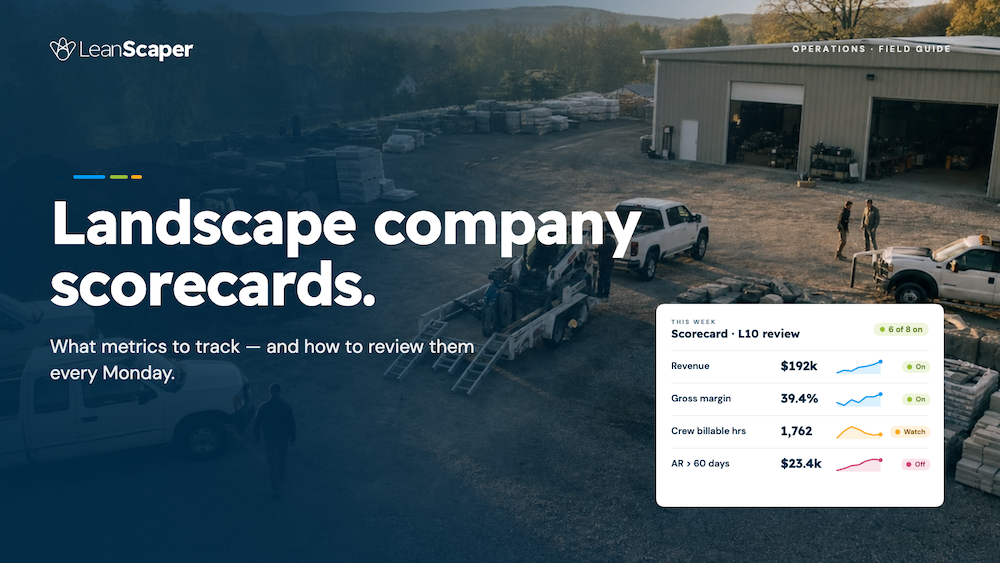

If you run a landscape company, you probably already know when the business is busy.
What is harder to know is whether the business is actually performing well.
A lot of landscape companies are operating with numbers scattered across accounting software, estimating tools, spreadsheets, job costing reports, and people’s heads. That usually leads to the same problems:
- leadership meetings become opinion-driven
- teams are unclear on what success looks like
- issues get discovered too late
- accountability gets fuzzy
- the owner ends up carrying too much of the business mentally
That is where a scorecard comes in.
A landscape company scorecard gives you a simple, repeatable way to track the numbers that matter most, review them consistently, and make better decisions before small problems become expensive ones.
In this article, we’ll walk through:
- what a landscape company scorecard is
- which metrics matter most
- how to structure your scorecard
- how to review it weekly
- why most manual scorecards eventually break down
- how LeanScaper AI helps landscape companies run scorecards as part of a complete operating system
What is a landscape company scorecard?
A landscape company scorecard is a focused set of business metrics that helps leadership see whether the company is on track or off track.
It is not just a spreadsheet.
It is not just a dashboard.
And it is not just a P&L.
A good scorecard gives your team:
- Visibility into how the business is performing
- Alignment around the same important numbers
- Accountability through clear metric ownership
- Improvement through regular review and action
The point is not to admire numbers. The point is to use them to run the business better.
Why landscape companies need scorecards
Landscape businesses are operationally complex.
You are balancing some combination of:
- maintenance work
- enhancements
- design/build projects
- irrigation
- snow
- crews in the field
- office coordination
- equipment and inventory
- customer retention
- estimating accuracy
- labor efficiency
- safety and training
That complexity creates a lot of opportunities for drift.
A company can be busy and still have:
- weak margins
- labor overruns
- declining customer retention
- low close rates
- poor divisional performance
- training gaps
- rising rework
Without a scorecard, leadership is usually reacting after the fact.
With a scorecard, leadership gets a clearer view of what is happening while there is still time to respond.
What metrics should a landscape company track?
The biggest mistake most companies make is trying to track too much too early.
You do not need 40 metrics on day one.
A better starting point is 8 to 12 metrics, spread across the four core areas of the business:
- Finance
- Operations
- People
- Revenue
Here are some of the strongest starter metrics for a landscape company scorecard.
Finance metrics to track
These metrics help you understand whether the business is financially healthy.
Good starter finance metrics include:
- Total Revenue
- Gross Margin %
- Net Profit
- Overhead %
- Revenue per Labor Hour
- Accounts Receivable Aging
These numbers help answer questions like:
- Are we making enough money on the work we do?
- Is labor efficiency improving or getting worse?
- Are overhead costs creeping up?
- Are we collecting cash fast enough?
Operations metrics to track
These metrics show how well the work is getting done.
Good starter operations metrics include:
- Estimated vs Actual Hours
- Jobs Delivered Under Budget
- On-Time Completion Rate
- Rework %
- Crew Efficiency
- Equipment Downtime
These numbers help answer questions like:
- Are crews running over hours?
- Which work types are causing margin leaks?
- Where are we missing operational discipline?
- Are equipment issues slowing us down?
People metrics to track
These metrics show whether your team is healthy, stable, and improving.
Good starter people metrics include:
- Employee Retention Rate
- Training Completion Rate
- Safety Incident Rate
- Absenteeism Rate
- Productivity Rate
These numbers help answer questions like:
- Are we keeping good people?
- Are we training consistently?
- Are safety issues increasing?
- Do we have crew-level or department-level skill gaps?
Revenue metrics to track
These metrics help you understand growth, demand, and customer performance.
Good starter revenue metrics include:
- Close Rate
- Lead Conversion Rate
- Customer Retention Rate
- Average Proposal Value
- Referral Rate
- Upsells per Customer
These numbers help answer questions like:
- Are we turning leads into work?
- Are we retaining the right customers?
- Is sales performance improving?
- Are we doing enough with the customers we already have?
Why your scorecard should be broken down by division
One of the biggest scorecard mistakes is using only company-wide numbers.
That sounds clean, but it can hide real problems.
For example, maintenance and install should not always share the same performance targets. Revenue per labor hour, margin profile, and production expectations often differ a lot across divisions and crew types.
A better scorecard structure often includes:
- company-level scorecard
- division-level scorecards
- in some cases, crew-level metrics
That creates clearer accountability and a more realistic picture of performance.
If one division is winning and another is slipping, leadership needs to see that quickly.
How to build a simple scorecard
If you are building your first scorecard, keep it simple.
Step 1: Pick 8 to 12 metrics
Choose the numbers tied to your biggest current challenges.
Step 2: Organize them by pillar
Make sure the scorecard is balanced across Finance, Operations, People, and Revenue.
Step 3: Set targets
Base targets on real past performance, current goals, and what each team can actually influence.
Step 4: Assign owners
Every metric should have one accountable owner.
Step 5: Review actuals weekly
Do not wait for perfect numbers. Current numbers reviewed regularly are more useful than perfect numbers reviewed occasionally.
How to run a weekly scorecard review
A weekly scorecard review does not need to be long.
In most companies, 15 to 30 minutes is enough if the right people are in the room and the right numbers are being reviewed.
A simple agenda looks like this:
1. Review all metrics quickly
Move through the scorecard at a high level.
2. Confirm what is on track
Celebrate wins and positive movement.
3. Flag what is off track
Focus on yellow and red metrics.
4. Discuss root cause
What is actually driving the miss?
5. Assign corrective action
What needs to happen before the next review?
6. Confirm owner and deadline
Every action item needs one owner and one due date.
That is what turns a scorecard from reporting into management.
Common scorecard mistakes
If your scorecard is not helping the business, one of these is usually the reason.
1. Tracking too many metrics
Too much data creates weak focus.
2. Reviewing too inconsistently
If the scorecard is not reviewed every week or every month, trends are hard to trust.
3. Using metrics with no owner
If nobody owns the number, nobody improves it.
4. Looking only at company-wide numbers
That hides divisional and crew-level issues.
5. Tracking numbers without action
Red metrics should trigger follow-up, not just conversation.
6. Building a scorecard that is too hard to maintain
If the process depends on too much manual effort, it usually falls apart.
Why spreadsheets eventually hit a wall
A spreadsheet is often a fine place to start.
But most landscape companies eventually run into the same issues:
- updates get inconsistent
- different people use different versions
- ownership becomes unclear
- review notes are disconnected from the numbers
- action items live in a separate system
- visibility is limited to whoever has the file open
That is why scorecards are much more powerful when they live inside a real operating system.
How LeanScaper AI helps landscape companies run scorecards for real
LeanScaper Scorecards gives landscape companies a more structured way to run the scorecard process.
Instead of using a static worksheet, teams can use LeanScaper to:
- track the numbers that matter most
- organize metrics across Finance, Operations, People, and Revenue
- create clearer ownership
- build a repeatable weekly review rhythm
- improve accountability over time
More importantly, scorecards inside LeanScaper are not isolated.
They sit inside a broader operating system for landscape contractors that also includes:
- LeanBoards for workflow and follow-through
- Huddles for turning meetings into action
- Agents for focused AI help
- Inventory for material and supply visibility
That matters because numbers alone do not improve the business.
Numbers need to connect to:
- conversations
- decisions
- owners
- action
- follow-through
That is the difference between a dashboard and an operating system.
Start simple, then build the system
If you do not have a scorecard yet, start simple.
Pick 8 to 12 metrics. Assign owners. Review them weekly. Act on what you see.
That alone will create more clarity than most landscape companies have today.
But if you want to run this process consistently across your leadership team, spreadsheets usually are not enough for long.
That is where LeanScaper AI can help.
Ready to build your scorecard?
If you want a simple starting point, download the Landscape Scorecard Starter Kit and build your first scorecard manually.
If you want to move from a worksheet to a real system, check out LeanScaper Scorecards and see how it fits into the full LeanScaper AI platform It's completely free to join and no credit-card is required.
